
Excerpt from my notebook/diary

Tuesday, Dec. 30th, 2025
Now that I’m back to reading at such a high clip, it suddenly seems effortless again to read at least a book a day. Moreover, I feel like myself again. No longer a desire to lead a conformist life; rather a sense that I can carve out my own little niche in the world. Reading about Satie, and how he lived, proved inspiring. But it was really an errant quote from Pessoa (also from the Satie book1), that really proved helpful. Here it is:
“The truly wise man is the one who can keep external events from changing him in any way. To do this, he covers himself with an armour of realities closer to him than the world’s facts and through which the facts, modified accordingly, reach him.” -Fernando Pessoa2
I understand exactly what he means, and it resonates so deeply within me. No doubt others would find it alarming, offensive even. After all, isn’t the man of reason he who, when the facts change, adjusts his own position accordingly? Against this myth of the rational man, Pessoa argues for what might be called a hermeneutic commitment, i.e. to see and filter the world through a certain conceptual lens, a constant project of interpretation or sublimation through which one truly gains access to the world. Not a passive recipient of information, but an active agent. What Pessoa thus deems “wisdom” is really a way of fortifying oneself with the things that are more real than the world of facts: books, films, art, poetry, music. And by means of constantly tending to this reality one can withstand the constant barrage of the factual, the tyranny of information.
This is what Walter Benjamin, in his essay Experience and Poverty called “a new type of barbarism”.3 And yet, pace Benjamin, the goal is to therefore confront the poverty of experience by starting again, making new beginnings, taking nothing for granted. As he puts it, to put a ‘positive’ spin to this barbarism is “to start fresh, to make do with little, to rebuild with next to nothing.”4 Thus ‘wisdom’ is not a turning inward, or a looking away, but rather the process by which we -each for ourselves and yet together- confront the present and begin living in accordance with what Aristotle called the kalon; the noble, the beautiful, the virtuous.
And yet for Benjamin each of us has to do it for ourselves. One cannot rely on abstract maxims (in today’s parlance so-called ‘rules-for-life’). Instead, the task is to carve out a rich existence, reading, writing, creating, taking it all in. This is what Benjamin calls ‘presence of mind’. “The here and now of virtue is not an abstract action dictated by maxims, but is guided by presence of mind.” This presence of mind, a means of paying attention (dare operam), is thus what it means to be wise -not to espouse abstract wisdom, but to cultivate a critical and engaged curiosity, through which to remain intellectually and creatively alive to the world. No easy task, but what else is there?
To briefly return to the book about Satie, there’s a line from the author, Ian Penman, that appeals to me very much: about how Socrates modeled a certain gleeful/critical wisdom. Maybe this is what we ought to be doing as well…
“Socrates was known in his time for constitutional impiety. He was something of a clown, holy fool, or trickster. Happily mocking the Gods, as opposed to the tragic experience of being mocked by them. At the very root of Western philosophy, then, this excluded pharmakon: to be deeply serious but also frolicsome, lighthearted, whimsical.”5
I like this idea very much. I find it to be very true in my own life. In order not to despair, I have to stay alive to the world and to all that it has to offer. And when I’m doing well, and taking care of myself, then the ideas begin to flow, and I’m able to think more clearly and make new connections. It’s a commitment to the work, in which I also feel more alive and in tune with myself and my sensibilities. And that’s the only way I know how to live.
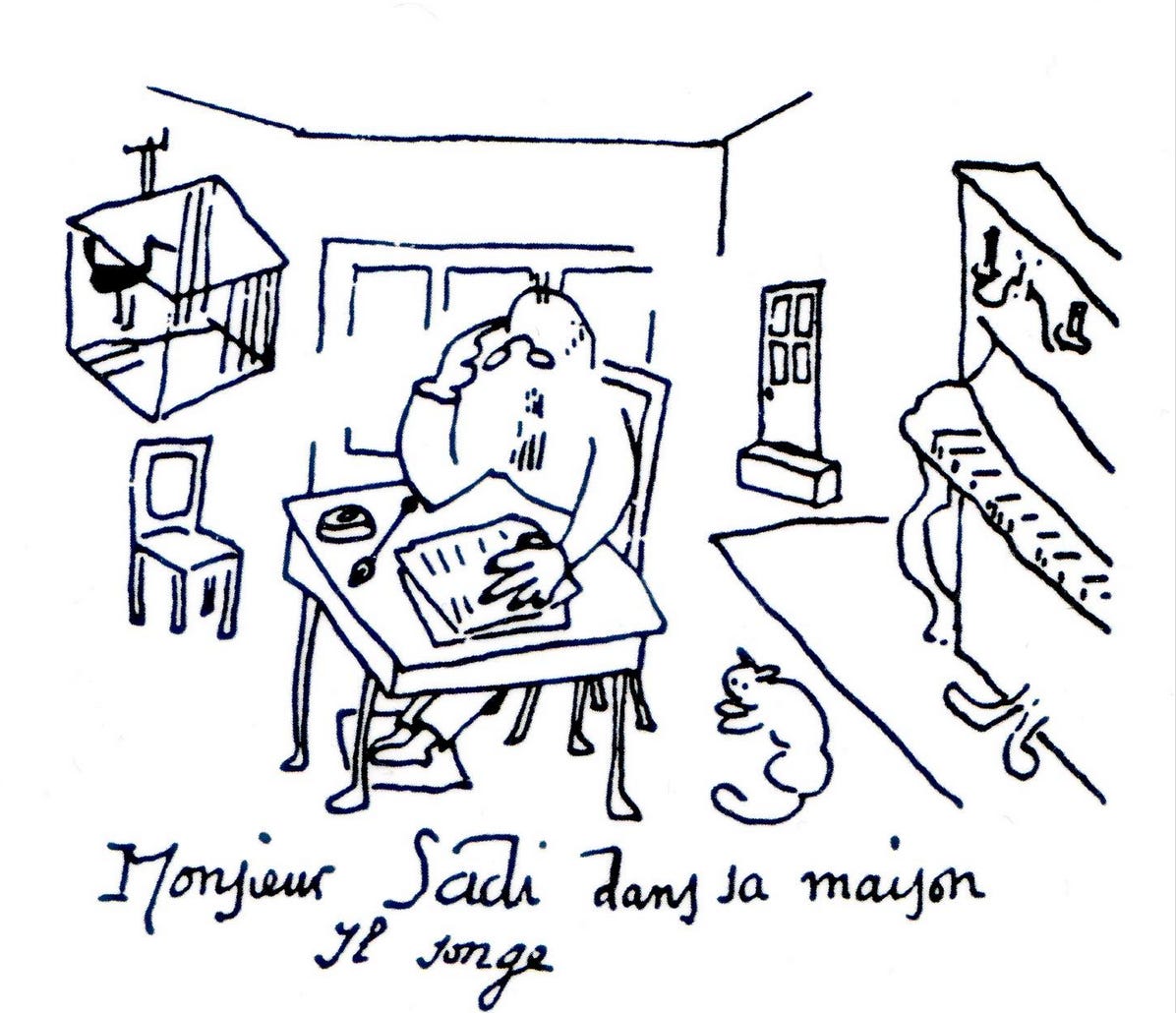
PS: After transcribing this entry from my diary, I realized that I had omitted actually saying anything about Satie, even though reading about him started me on this reverie. I’ve included a sketch that Satie made of himself, which he sent in a letter to Cocteau. It’s a bit of a mysterious sketch, as it features a cat and a bird… and nobody really knows whether Satie actually had any pets. Plus, I’ll leave you with the words Satie is reported to have said on his deathbed “Ah! the cows…”
I’ll share some more stories about Satie’s life in next week’s podcast. Until then, happy new year!
Julian
Erik Satie: Three Piece Suite, by Ian Penman
as cited by Ian Penman in ‘Erik Satie: Three Piece Suite’, p. 192
The Storyteller Essays, by Walter Benjamin (NYRB edition), p.42-47
ibidem, p. 43
Erik Satie: Three Piece Suite, p. 129.
I love your work!
Your daily notes pair beautifully with my cup of coffee!
Keep up the goodness in 2026!
Thank you, Julian.
Thank you Julian for sharing your thoughts, and these ones in particular. I find your outlook on life so comforting as it resonates deeply with me, yet it has been difficult in my own life to find others who hold similar perspectives. I appreciate your determined hope and passion for learning and discovering the depths of being alive. Happy new year and all the best to you.